


Compounded GLP-1 Medications (e.g. Semaglutide and Tirzepatide): Why South Africans Should Be Cautious
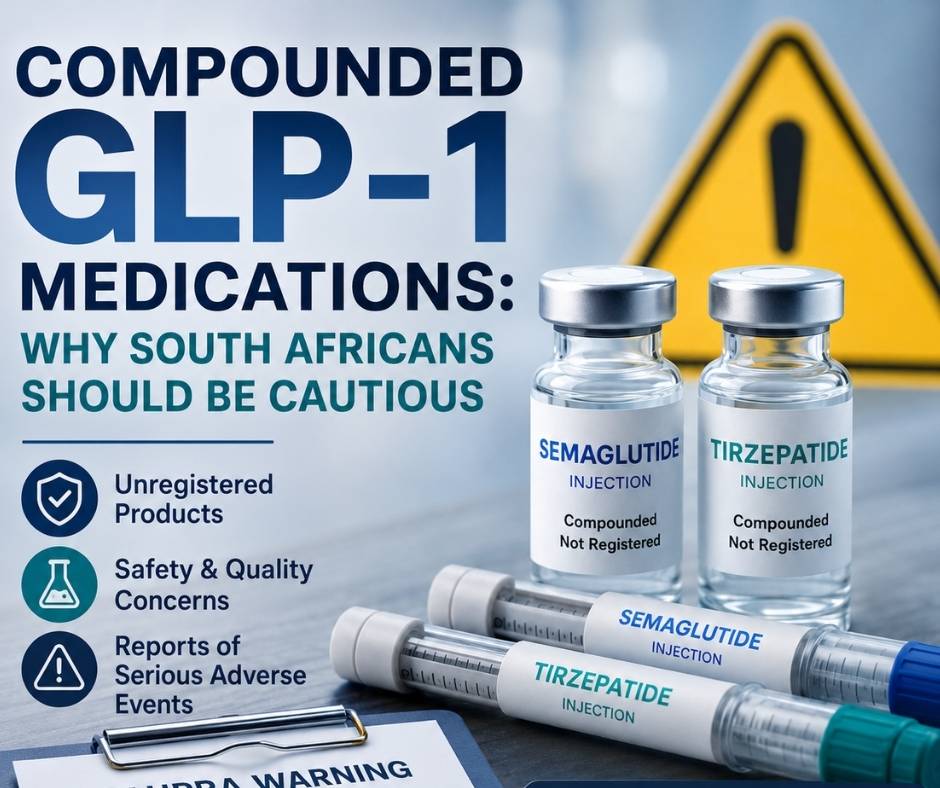
Table of Contents
The growing popularity of GLP-1 medications
GLP-1 receptor agonists (e.g. Semaglutide and Tirzepatide) have become increasingly popular for the treatment of obesity and overweight. These medications can help people lose weight by reducing appetite, increasing feelings of fullness, and improving blood sugar control.
As demand for GLP-1 medications has increased, a growing number of companies have begun offering so-called “compounded” GLP-1 products. These products are often marketed as cheaper alternatives to registered medications. However, recent action by the South African Health Products Regulatory Authority (SAHPRA) has raised serious concerns about the safety and legality of these products.
What are compounded GLP-1 medications?
Compounding is the process of preparing a medication for an individual patient based on a specific prescription from a healthcare professional.
In South Africa, compounding is legally permitted only under strict circumstances for individual patients. It is not intended to be used as a mechanism for large-scale manufacturing, advertising, or commercial distribution of medicines.
Some pharmacies and companies have been producing compounded versions of semaglutide, tirzepatide, or combinations of both medications and marketing them for weight loss. These products are often referred to as “compounded GLP-1 medications.”
SAHPRA’s enforcement action
On 23 May 2026, SAHPRA announced that it had intensified enforcement action against the unlawful manufacturing and distribution of unregistered GLP-1 and GIP medicines containing semaglutide, tirzepatide, or combination formulations.
A joint investigation by SAHPRA and the South African Pharmacy Council (SAPC) at a pharmacy facility in Pretoria (IDexis) revealed significant regulatory violations. As a result, all GLP-1 and GIP injectable products found on site were seized and the company was instructed to initiate a full product recall.
The investigation found that products were being manufactured and supplied outside the legal framework that governs pharmaceutical compounding in South Africa.
Why are compounded GLP-1 products a concern?
According to SAHPRA, the inspection identified several serious concerns:
1. Unregistered medicines
The products being manufactured were not registered medicines approved by SAHPRA.
Registered medicines undergo extensive review to assess their quality, safety, and effectiveness before they can be supplied to patients.
2. Quality and purity concerns
The investigation found that active pharmaceutical ingredients (APIs) were allegedly being imported illegally and that there was no adequate analytical testing to confirm:
- Identity of the ingredients
- Potency of the medication
- Purity of the product
- Consistency between batches
Without proper testing, patients cannot be certain what they are injecting.
3. Sterility risks
Injectable medications must be manufactured under highly controlled sterile conditions.
SAHPRA reported deficiencies including:
- Inadequate sterile manufacturing conditions
- Insufficient equipment for aseptic preparation
- Lack of appropriate air filtration and environmental controls
- Increased risk of contamination
Contaminated injectable products may lead to serious infections and other complications.
4. Lack of safety monitoring
The facility reportedly did not have an appropriate pharmacovigilance system in place.
Pharmacovigilance is the process of monitoring, investigating, and reporting adverse drug reactions. This is an essential component of medicine safety.
5. Reports of serious adverse events
SAHPRA has noted reports of adverse events, including hospitalisations, associated with the use of certain compounded GLP-1 products.
While investigations continue, these reports highlight the potential risks associated with unregulated products.
Are registered GLP-1 medications different?
Yes. Registered Semaglutide and Tirzepatide supplied through legitimate healthcare channels are manufactured under strict quality standards and are subject to regulatory oversight. In South Africa, Mounjaro is currently the only SAHPRA-registered tirzepatide medication, while Wegovy and Ozempic are the only SAHPRA-registered semaglutide medications. .
Patients can have greater confidence that:
- The medication contains the correct active ingredient.
- The dosage is accurate.
- The product has been tested for quality and sterility.
- Safety information is continuously monitored.
How can patients protect themselves?
If you are considering GLP-1 treatment for weight management:
- Consult a registered healthcare professional.
- Obtain medication from reputable pharmacies.
- Be cautious of unusually cheap alternatives.
- Avoid products marketed as compounded semaglutide, compounded tirzepatide, or custom GLP-1 blends.
- Ask whether the medication is a registered product.
- Report suspected adverse reactions to your healthcare provider and SAHPRA.
Frequently Asked Questions
Are compounded GLP-1 medications safe?
Recent SAHPRA investigations have identified significant concerns regarding the quality, sterility, manufacturing standards, and regulatory compliance of certain compounded GLP-1 products. Patients should avoid compounded GLP-1 medications and use only registered medicines prescribed by a healthcare professional.
Why are compounded GLP-1 medications often cheaper?
Compounded products may bypass many of the quality control, manufacturing, testing, and regulatory requirements that apply to registered medicines. Lower prices may come at the expense of quality assurance and patient safety.
Can compounded GLP-1 medications contain the wrong dose?
Potentially yes. Without appropriate testing and quality controls, there may be uncertainty regarding the potency and consistency of compounded products.
Has SAHPRA taken action against compounded GLP-1 products?
Yes. SAHPRA and the South African Pharmacy Council have conducted enforcement actions, seized products, and initiated recalls involving unlawfully manufactured and distributed compounded GLP-1 medicines.
What should I do if I have used a compounded GLP-1 product?
If you experience any side effects or concerns, contact your healthcare provider promptly. Serious adverse reactions should also be reported to SAHPRA.
Which GLP-1 medications should I trust?
Patients should use only SAHPRA-registered medications (e.g. Wegovy or Mounjaro) supplied through legitimate healthcare providers and licensed pharmacies.
