


GLP-1 in South Africa: what these medications are and how they work
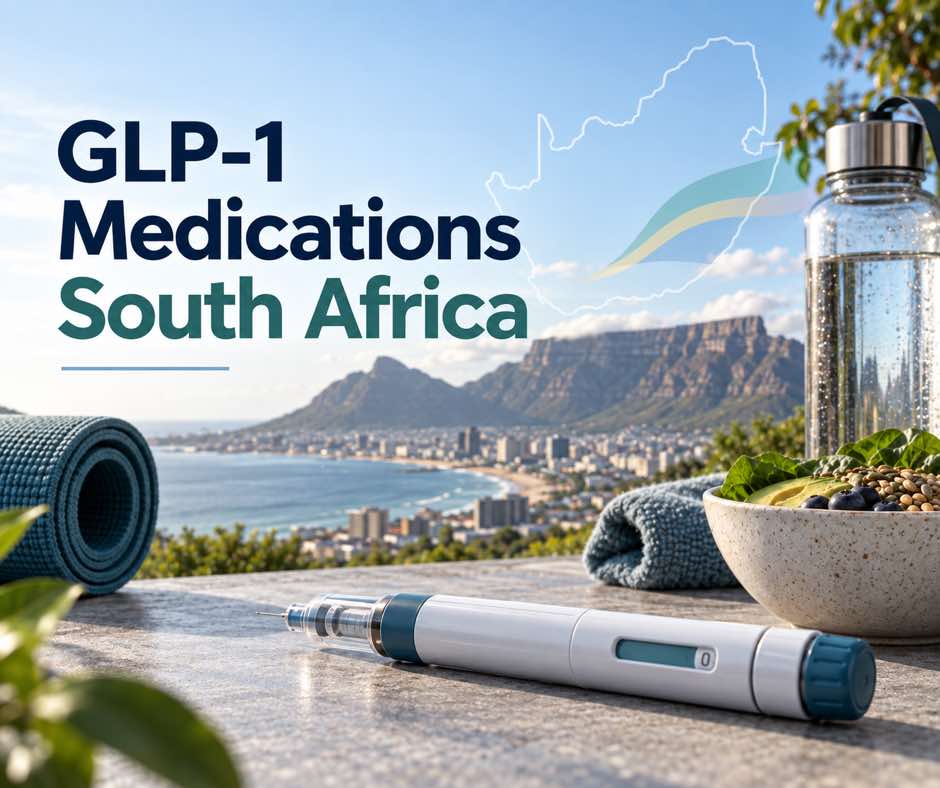
If you have typed “GLP-1 South Africa” into Google at 11pm, you probably keep seeing the same three names, Ozempic, Wegovy and Mounjaro, and you are trying to work out what the actual class of medicine is and whether it is legal and available here. Short version: GLP-1 medicines are a family of prescription injections (and one tablet) that copy a gut hormone your body already makes. They were built for type 2 diabetes. Some are now registered for weight management too. This page explains what they are, how they work in plain terms, what the side effects are, and which ones are registered by SAHPRA right now.
Table of Contents
What GLP-1 medications actually are
GLP-1 stands for glucagon-like peptide-1. It is a hormone your small intestine releases after you eat. It tells your pancreas to release insulin, it slows down how fast your stomach empties, and it acts on appetite centres in your brain. The problem is that your own GLP-1 breaks down within a couple of minutes, so it does not hang around long enough to be a treatment on its own.
The medicines are called GLP-1 receptor agonists. “Agonist” just means they switch on the same receptor your natural hormone does, except they are engineered to last for about a week instead of two minutes. That is why most of them are a once-weekly injection.
Two active ingredients dominate the conversation in South Africa:
- Semaglutide. A pure GLP-1 receptor agonist. This is the ingredient inside Ozempic, Wegovy and the oral tablet Rybelsus.
- Tirzepatide. This one is slightly different. It switches on two receptors, GLP-1 and a second gut hormone receptor called GIP (glucose-dependent insulinotropic polypeptide). People call it a dual agonist. It is the ingredient in Mounjaro.
So when you read about “GLP-1 drugs” as a group, tirzepatide usually gets lumped in even though it is technically a GLP-1/GIP medicine. Same family, one extra target.
How GLP-1 medicines work in the body
Three things happen, and they stack.
First, blood sugar. GLP-1 tells the pancreas to release insulin when your blood glucose is high, and it lowers a hormone called glucagon that pushes sugar up. This is glucose-dependent, meaning it mostly acts when your sugar is actually raised, which is part of why these medicines carry a lower risk of dangerous low blood sugar on their own than older diabetes drugs.
Second, your stomach. The medicine slows gastric emptying, so food sits longer and you feel full sooner and for longer after a meal. That fuller-for-longer feeling is what most people notice first.
Third, and this is the big one for weight, your brain. GLP-1 receptors sit in the parts of the brain that manage hunger and reward. Switching them on turns down appetite and the constant “food noise” a lot of people describe. You eat less because you want less, not because you are forcing yourself.
Tirzepatide adds the GIP receptor on top of all of that, and in head-to-head studies that dual action has produced larger average weight loss than semaglutide. Bigger effect is not automatically the right choice for everyone though, and that is a conversation for a doctor, not a search bar.
Which GLP-1 medications are registered in South Africa
This is the part that trips people up, so here it is straight. When people search GLP-1 South Africa, the honest answer is that registration and real-world use are two different things, and SAHPRA (the South African Health Products Regulatory Authority) is the body that decides what a medicine is officially approved to treat.
Wegovy (semaglutide)
Registered by SAHPRA for chronic weight management, and it launched locally in August 2025. It is the first GLP-1 formally approved in South Africa specifically for weight, and it comes in a set of dose strengths that step up over time.
Ozempic (semaglutide)
Same active ingredient as Wegovy, but Ozempic is registered here for type 2 diabetes (and to lower cardiovascular risk in certain patients). It is sometimes prescribed for weight loss, but that is an off-label decision made under a doctor’s clinical judgement, not a registered weight-loss indication. SAHPRA has said this plainly.
Mounjaro (tirzepatide)
Registered in South Africa for type 2 diabetes, with the local launch in December 2024, and since October 2025 it is also registered by SAHPRA for chronic weight management, as an add-on to a reduced-calorie diet and more activity for adults who meet the clinical criteria. So Mounjaro now carries both registered indications here. Which one applies to you is still a clinical decision a doctor makes after assessing you.
Why does this matter to you? Because “registered for weight” and “used for weight under a doctor’s supervision” are not the same legal thing, and any site telling you otherwise is glossing over it. A registered product bought through a licensed pharmacy is also your protection against the falsified semaglutide SAHPRA has warned is circulating. If you want to understand that risk properly, read our piece on compounded and unregistered GLP-1 medications before you buy anything cheap online.
Who they are for (and who they are not for)
In broad strokes, GLP-1 medicines are considered for two groups. People with type 2 diabetes who need better blood sugar control, and people living with obesity or who are overweight with a weight-related health condition, where a doctor decides medication is a reasonable step alongside diet and activity changes.
They are not a shortcut for someone who wants to lose a few kilograms for a wedding. They are prescription medicines with real effects and real risks, and a proper assessment looks at your weight history, your other conditions, your current medicines, and your family history.
Some people should not use them at all. That includes anyone with a personal or family history of medullary thyroid cancer or the syndrome MEN 2, and there are cautions in pregnancy, in people with a history of pancreatitis, and in certain gut conditions. This is exactly the kind of thing a consultation exists to catch. If you are still weighing up whether medication is even the right route for you, our guide on which weight loss treatment might suit you walks through the options.
How you take them and what to expect
Most GLP-1 medicines are a once-weekly injection you give yourself with a pre-filled pen, usually into the stomach, thigh or upper arm. The needle is short and fine. Rybelsus is the exception, a daily tablet taken on an empty stomach with a small sip of water, first thing.
You do not start on the full dose. Everyone starts low and steps up slowly over weeks or months. This is deliberate. The gradual increase is what keeps the side effects manageable while your body adjusts. Jumping to a high dose fast is how people end up feeling awful, and it is not safer or faster.
What to expect week to week: appetite usually drops within the first few weeks. Weight change is gradual, not overnight, and it depends heavily on what you do alongside the medicine. These are not a replacement for eating reasonably and moving. They make those changes easier to stick to, which is the point. When people stop the medicine, appetite tends to return and some weight often comes back, so it is worth thinking of this as a longer-term plan you discuss with a doctor, not a two-month fix.
Side effects and safety
The common side effects are almost all gut-related, because you are slowing down digestion. Nausea is the most reported one. Others include vomiting, diarrhoea, constipation, burping and abdominal discomfort. For most people these are mild to moderate, worst in the first few weeks and after each dose increase, and they settle as the body adjusts. Eating smaller portions and going easy on very fatty or very rich meals helps a lot.
The less common but more serious things to know about: pancreatitis (severe, persistent stomach pain that can spread to your back needs urgent attention), gallbladder problems, and dehydration from vomiting or diarrhoea. There is a specific contraindication around medullary thyroid cancer and MEN 2, mentioned above. Large reviews have not found a clear increase in thyroid cancer with semaglutide, but the caution stays in place for people with that personal or family history.
One practical point that matters if you are having surgery or a procedure with sedation: tell your anaesthetist you are on a GLP-1 medicine, because the slowed stomach emptying changes how they manage you. This explains why these are prescription-only and why an assessment is needed before you start.
Cost and access, honestly
GLP-1 medicines are not cheap, and pretending otherwise helps nobody. Prices in South Africa have been moving, and in early 2026 the maker of Wegovy announced meaningful reductions on its starting dose, which brought the entry cost down noticeably from where it launched. Even so, you are looking at an ongoing monthly cost, and because you titrate up over time, the dose you pay for can change.
Medical aid coverage varies a great deal between schemes and plans, and weight-management indications are often treated differently to diabetes ones, so it is worth asking your scheme directly what they cover and under what conditions. Access also depends on stock, which has been patchy globally for these medicines at various points.
A word on the “bargains”. If you find semaglutide or tirzepatide far below pharmacy prices, especially compounded or imported versions sold online, treat that as a warning sign rather than a win. SAHPRA has flagged falsified products in the local market. The whole reason to go through a registered product and a licensed pharmacy is that you actually get what the label says, at the dose it says.
How to get GLP-1 medication in South Africa
Because these are prescription-only, the route is the same whichever medicine turns out to be appropriate. You need a consultation with a doctor who can assess your health, check for the contraindications, confirm whether a GLP-1 medicine is a sensible option for your situation, and if so, prescribe it so you can fill it at a licensed pharmacy. That assessment is what keeps you safe.
If this kind of treatment could be right for you, you can start a consultation for weight-loss guidance here. An HPCSA-registered doctor will review your health and history, and if it is clinically appropriate, a prescription can be issued. A doctor will talk through what is appropriate and available for you, rather than you having to guess from a search results page.
FAQ
Is GLP-1 legal in South Africa?
Yes. Several GLP-1 medicines are registered by SAHPRA and sold through licensed pharmacies on prescription. What differs is what each one is officially registered to treat. Wegovy is registered for weight management, and Mounjaro is registered for both type 2 diabetes and (since October 2025) chronic weight management, while Ozempic is registered for type 2 diabetes and used for weight only off-label under a doctor’s judgement.
What is the difference between Ozempic and Wegovy?
They contain the same active ingredient, semaglutide. In South Africa, Ozempic is registered for type 2 diabetes and Wegovy is registered for chronic weight management, and they come in different dose ranges. Same molecule, different registered use and packaging.
Is Mounjaro a GLP-1 medicine?
Mounjaro (tirzepatide) works on the GLP-1 receptor and also on a second one called GIP, so it is often described as a dual GLP-1/GIP agonist. People group it with the GLP-1 class, but it has that extra target, which is linked to larger average weight loss in studies.
Which GLP-1 is best for weight loss?
There is no single answer, and “best” depends on your health, your other conditions, tolerance of side effects, cost and availability. Studies show tirzepatide tends to produce more weight loss on average than semaglutide, but the right choice for you is a clinical decision. That is what the consultation is for.
Do you need a prescription for GLP-1 medication in South Africa?
Yes. All of these are prescription-only medicines. Getting one legally and safely means a consultation, a clinical assessment, and a prescription filled at a licensed pharmacy. Anywhere selling them without that is a red flag.
What happens when you stop taking a GLP-1?
Appetite generally returns, and many people regain some of the weight they lost. That is why doctors tend to frame these as part of a longer-term plan alongside diet and activity, not a short course. Talk to a doctor before stopping and restarting.
Are the cheaper compounded versions safe?
Compounded and unregistered versions are not held to the same quality checks as registered products, and SAHPRA has warned about falsified semaglutide in the country. Sticking to a SAHPRA-registered product from a licensed pharmacy is the safer route.
Medically reviewed by a South African HPCSA-registered medical practitioner. Last reviewed: July 2026.
This article is general health information, not medical advice or a prescription. Medicines named here are prescription-only; a prescription requires a consultation and clinical assessment. Speak to a doctor about what is appropriate for you.
Sources: SAHPRA (South African Health Products Regulatory Authority), NHS: Semaglutide, Cleveland Clinic: GLP-1 agonists, StatPearls: Semaglutide (NCBI), Aspen / SAHPRA approval of Mounjaro for chronic weight management (SENS, October 2025)
